Module 1: General Probability
Sample spaces, counting, conditioning and Bayes' theorem: turning words into events before computing anything
Throughout the chapter we follow Anact Mutual, a fictional insurer selling auto, home and health cover. Its numbers are invented for teaching.
1. The model comes first
A probability question describes an experiment. Before any formula, write down three things:
- the sample space : every outcome, at the level of detail the question needs;
- the events: subsets of named in the question;
- the probability: a rule that gives each event a number, with , , and when and cannot both happen.
Those three rules (the axioms) are all there is. Every identity in this module is derived from them.
1.1 Three consequences of the axioms
Each of these follows in one line, and each is used constantly.
- Complement. and are disjoint and together make , so , that is .
- Impossible event. Take : .
- Monotonicity. If , then with the two pieces disjoint, so .
Monotonicity is a free sanity check: the probability of "both" can never exceed the probability of either one, and "at least one" can never be below either one.
1.2 Detail and equal likelihood
The level of detail matters. Drawing two claims from a file can be modelled as an ordered pair (first, second) or as an unordered pair; both are correct, but the numerator and the denominator of a probability must use the same one.
Equal likelihood is an assumption to check, not a consequence of listing outcomes.
Example 1.1: Picking a region is not picking a policy
Anact Mutual has 600 policies in the North, 300 in the Central region and 100 in the South. A policy is chosen at random for audit.
- The sample space at the right level is the 1,000 policies, each with probability .
- So .
- Listing the regions as three outcomes and giving each answers a different experiment: pick a region uniformly, then a policy within it.
Both experiments are legitimate; the question decides which one is meant. "A policy is chosen at random" means the first.
2. Event identities from a partition
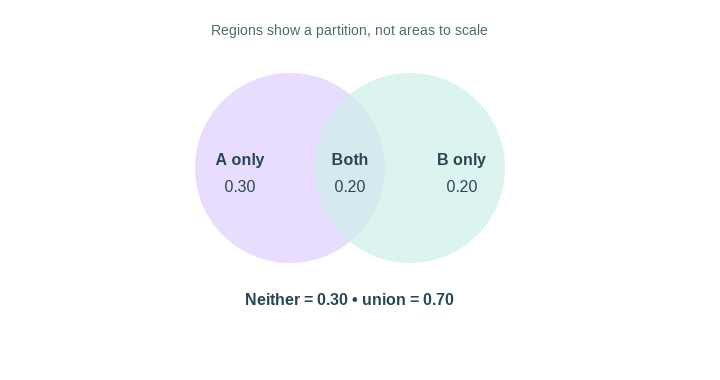
Most identities come from splitting an event into pieces that do not overlap. For two events,
and the three pieces are disjoint, so their probabilities add. Since , and similarly for :
Adding and counts the overlap twice; subtracting it once corrects that. Exactly one of the events removes the overlap from both:
Example 2.1: Two policies in one household
In Anact Mutual's client base, 45% hold auto cover, 28% hold home cover and 16% hold both. Then
| Event | Probability |
|---|---|
| At least one policy | |
| Exactly one policy | |
| Neither |
Check: exactly one (0.41) plus both (0.16) must equal at least one (0.57). It does.
2.1 De Morgan's laws
"Neither nor " is "not and not ", which is the complement of "at least one":
Proof. An outcome is outside exactly when it is outside and outside . The second law follows by applying the first to and and taking complements.
Interpretation. De Morgan turns a hard "and" into an easier "or", or the reverse. "Not both claims are large" is "at least one is small", which is often the quicker route.
2.2 Three events: inclusion–exclusion
For three events,
Proof by counting regions. The three circles of a Venn diagram cut into seven disjoint regions. Check how many times each region is counted on the right:
| Region lies in | Counted in | Subtracted in | Added in | Net |
|---|---|---|---|---|
| exactly one event | 1 | 0 | 0 | 1 |
| exactly two events | 2 | 1 | 0 | 1 |
| all three events | 3 | 3 | 1 | 1 |
Every region is counted exactly once, so the right side is .
An overlap must be counted once
Example 2.2: Three lines of cover
Among Anact Mutual's households, 52% hold auto, 33% home and 41% health; 21% hold auto and home, 17% auto and health, 13% home and health, and 7% all three.
At least one: .
Region by region. Peel the overlaps off each line, adding back the triple overlap that was removed twice:
| Region | Calculation | Probability |
|---|---|---|
| Auto only | 0.21 | |
| Home only | 0.06 | |
| Health only | 0.18 | |
| Exactly one | sum of the three | 0.45 |
| Exactly two | 0.30 | |
| All three | given | 0.07 |
| None | 0.18 |
Check: .
The four bars partition the sample space, so they add to 1. A region table is the fastest way to answer any 'exactly k' question.
3. Counting with one convention
When outcomes are equally likely, . The work is in counting, and the rule is to use the same ordering convention above and below the line.
- Ordered selections of from without replacement: .
- Unordered selections: , because each unordered set appears times among the ordered ones.
- Ordered selections with replacement: .
Example 3.1: Auditing claims, two ways
A file holds 10 claims, 4 of them large. An auditor picks 3 at random without replacement. What is the probability that exactly 2 are large?
Unordered. Choose 2 of the 4 large and 1 of the 6 small, out of all sets of 3:
Ordered. The large-large-small sequence can sit in 3 positions; each has ordered draws, out of :
Same answer, because both counts used one convention throughout. Mixing them (an ordered numerator over an unordered denominator) is the classic counting error.
3.1 Splitting into labelled groups
The number of ways to split distinct items into labelled groups of sizes (with ) is the multinomial coefficient
Proof. Choose the first group, then the second from what is left, and so on:
The intermediate factorials cancel in a telescope. The binomial coefficient is the case .
Example 3.2: Three adjusters, nine claims
Nine claims are assigned at random to three adjusters, three each. What is the probability that the three largest claims all go to the same adjuster?
- All assignments: .
- Favorable: pick the adjuster who gets the three large claims (3 ways), then split the other 6 claims 3 and 3 between the remaining two adjusters: ways. Total .
- Probability: .
The groups are labelled (each adjuster is a different person), so no division by the number of group orderings is needed. If the groups were unlabelled piles, both counts would be divided by and the probability would not change.
3.2 "At least two alike": go through the complement
"At least two" events of a kind are messy to count directly: they can happen in many overlapping ways. Their complement, "all different", is one clean product.
Example 3.3: Claims in the same month
Six claims arrive independently, each equally likely to fall in any of 12 months. What is the probability that at least two fall in the same month?
so .
Five claims are already more likely than not to produce a repeat. Coincidences are cheap because the number of pairs grows like k squared.
Why so high? With claims there are pairs, and each pair matches with probability . Six claims make 15 pairs, so a match somewhere is no surprise.
4. Conditional probability and independence
Learning that happened shrinks the sample space to . Probabilities inside it must be rescaled to add to 1:
Interpretation. is a full probability rule on its own: all the identities of Section 2 hold with "" added everywhere. For example .
Example 4.1: A two-way table
Anact Mutual's 1,000 health policyholders, by age and whether they claimed last year:
| Claimed | No claim | Total | |
|---|---|---|---|
| Under 40 | 60 | 540 | 600 |
| 40 and over | 80 | 320 | 400 |
| Total | 140 | 860 | 1,000 |
- .
- : conditioning keeps only the 40+ row.
- : conditioning keeps only the claimed column.
The two conditional probabilities use the same 80 policyholders but different denominators. Confusing them is the most common error in this chapter.
4.1 The multiplication rule
Rearranged, . Applied repeatedly, it gives the probability of a sequence:
Proof. Expand the right side with the definition: the denominators and cancel against the numerators of the previous factors.
Example 4.2: When is the first fraudulent claim found?
Of 12 claims, 4 are fraudulent. An investigator checks them one at a time in random order. The probability that the first fraudulent claim is the third one checked:
Each factor is conditional on what came before: after one clean claim, 7 clean claims remain among 11.
Follow joint probabilities before dividing
4.2 Independence
Events are independent when learning one does not change the other: , or equivalently .
In Example 4.1, , so age and claiming are dependent. Equivalently, , but .
Complements inherit independence. If and are independent, so are and :
Applying this twice, and are independent too. That is why "neither of two independent events" is .
4.3 Pairwise is not mutual
Three events are mutually independent when every pair is independent and . The last condition does not follow from the first.
Two claims are each large with probability , independently. Let : the first is large; : the second is large; : exactly one is large. Each event has probability , and each pair intersects in exactly one of the four equally likely outcomes, so each pairwise intersection has probability . But is impossible: if both are large, it is not "exactly one". So .
Knowing and together determines , even though any single one of them tells you nothing about .
5. Total probability and Bayes' theorem
If split the sample space into groups (a partition), any event splits along them:
Proof. with disjoint pieces, so ; apply the multiplication rule to each term.
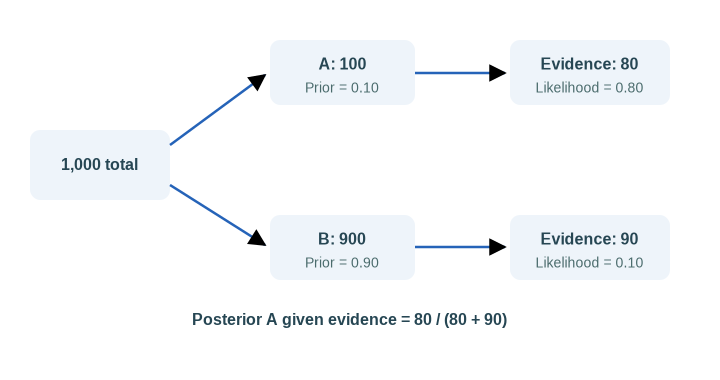
Reversing the conditioning uses the same joint probability twice: . So
Bayes' theorem is not a separate law; it is the definition of conditional probability applied in both directions.
Example 5.1: Which driver had the accident?
Anact Mutual's drivers are 60% low risk, 30% medium and 10% high, with annual accident probabilities 0.02, 0.05 and 0.15.
| Class | Prior | Accident probability | Joint |
|---|---|---|---|
| Low | 0.60 | 0.02 | 0.012 |
| Medium | 0.30 | 0.05 | 0.015 |
| High | 0.10 | 0.15 | 0.015 |
| Total | 0.042 |
So and . One accident lifts the chance that a driver is high risk from 10% to almost 36%.
5.1 Updating as evidence repeats
If accidents in different years are independent given the class, two accidents multiply the likelihoods:
Each accident multiplies the odds of 'high' against each other class by a likelihood ratio (0.15/0.02 = 7.5 against low, 3 against medium), so the posterior climbs fast.
The odds view. Bayes' theorem reads most cleanly in odds: posterior odds = prior odds × likelihood ratio. High against low starts at and each accident multiplies it by . Anything common to both groups cancels.
Proof. Write Bayes' formula for and for and divide: the shared denominator cancels, leaving
6. Reliability: series, parallel and k-out-of-n systems
Series and Parallel Component Systems
Let a system consist of components with independent operational probabilities (and failure probabilities ).
- Series System: The system operates if and only if all components operate:
- Parallel System: The system operates if at least one component operates:
-out-of- Redundant Voting Systems
A system operates if at least out of identical independent components (each with reliability ) operate:
For a 2-out-of-3 voting system:
7. Case study: Anact Mutual's health screening
Anact Mutual is considering a screening test for a condition that sharply raises expected health claims. The test detects the condition 95% of the time (sensitivity) and gives a false positive 4% of the time. Among standard applicants, 2% have the condition.
Step 1: what a positive result means. By Bayes,
Two out of three positives are false alarms. Declining every positive applicant would turn away about two healthy applicants for every one with the condition.
Step 2: the answer depends on who is tested. The same test gives very different positive predictive values in different populations:
The test does not change; the prior does. Applicants referred by a doctor (prevalence 10%) give a positive predictive value of 0.725.
Step 3: a confirmatory test. If a second, independent test (given the applicant's true status) is run on positives, the likelihood ratio applies again:
Step 4: what a negative result means. . A negative is very reassuring, because the condition was rare to begin with.
Step 5: the mixed pool. If 80% of applicants are standard (prevalence 2%) and 20% are referred (prevalence 10%), total probability gives an overall prevalence of , and a positive predictive value of 0.470 for a positive from the pool as a whole. Reporting that single number would hide that it is 0.326 for one group and 0.725 for the other.
Recommendation.
- Never decline on a single positive in the standard group: refer for a confirmatory test.
- Report predictive values by population, not one blended figure.
- Check that the two tests really are independent given status. If both react to the same unrelated factor, the second positive adds much less than the formula says (Section 5 warning).
8. Review sheet
| Idea | Formula or rule | Trap |
|---|---|---|
| Complement | counting "at least one" directly | |
| Union of two | forgetting the overlap | |
| Exactly one of two | subtracting the overlap only once | |
| Three events | add singles, subtract pairs, add the triple | omitting the triple term |
| Counting | one convention for order, top and bottom | ordered over unordered |
| Groups | dividing by when groups are labelled | |
| Conditional | using the wrong denominator | |
| Independence | confusing with disjoint | |
| Mutual independence | every pair and the triple | stopping at pairwise |
| Bayes | prior × likelihood, normalized | reading as |
9. Common traps
Trap 1: The Base Rate Fallacy in Medical Testing
- Trap: Assuming that if a diagnostic test is accurate (sensitivity = , specificity = ), an individual who tests positive has a probability of having the disease.
- Correction: If prevalence , the vast majority of positive tests are false positives. ().
Trap 2: Conflating "Mutually Exclusive" with "Independent"
- Trap: Setting when the problem states and cannot occur together.
- Correction: "Cannot occur together" means . Independence requires .
Trap 3: Sign Inversion in 3-Event Inclusion-Exclusion
- Trap: Writing .
- Correction: The triple intersection must be added back: . If you subtract it, you remove that region completely instead of counting it once.
Trap 4: De Morgan's Complement Confusion
- Trap: Believing .
- Correction: By De Morgan's Law, . Therefore, .
Trap 5: Inverting the Condition
- Trap: Equating the probability that a fraudulent claim is flagged with the probability that a flagged claim is fraudulent.
- Correction: . You must invert using Bayes' Theorem.
Trap 6: Assuming Sampling with Replacement in Small Portfolios
- Trap: Using binomial probability when drawing without replacement from a small claim batch.
- Correction: Drawing without replacement from a finite set requires the Hypergeometric distribution: .
Trap 7: "At Least One" vs. "Exactly One" Phrasing
- Trap: Computing when the stem asks for .
- Correction: .
Trap 8: Forgetting the Denominator in Conditional Partitions
- Trap: Calculating and stopping without dividing by .
- Correction: Conditional probability requires normalization by the marginal total probability .
Trap 9: Unconditional Independence vs. Conditional Independence
- Trap: Assuming that if Year 1 and Year 2 claims are conditionally independent given driver risk class , they are unconditionally independent.
- Correction: They are unconditionally correlated! A claim in Year 1 increases the posterior probability of being high-risk, which increases the unconditional probability of a claim in Year 2: .
Trap 10: Inverting False Positive Rate and Specificity
- Trap: Using specificity directly in place of the false positive rate in the denominator of Bayes' formula.
- Correction: False positive rate is .
Trap 11: Neglecting Overlapping Subsets in Multi-Stage Audits
- Trap: Summing probabilities of intersecting groups directly without subtracting the overlaps.
- Correction: Always construct a Venn diagram or apply inclusion-exclusion when subcategories are not explicitly certified as disjoint.
Trap 12: Permutation Order Overcounting
- Trap: Using permutations instead of combinations when the order of selection is irrelevant.
- Correction: When selecting a committee, audit batch, or claim portfolio, order does not matter; use .
Trap 13: Conditional Probability on Non-Zero Events
- Trap: Evaluating when .
- Correction: Conditional probability is undefined when conditioning on a measure-zero event.
Trap 14: Confusing with
- Trap: Automatically assuming without checking whether .
- Correction: Always include unless disjointness is explicitly stated.
Trap 15: Miscalculating the Complement of "At Least Two"
- Trap: Taking the complement of "at least two claims" as .
- Correction: The complement of is , which encompasses both and : .
10. Practice problems
Problem 1: Exactly one
, and . Find the probability that exactly one of and occurs.
- A0.50
- B0.60
- C0.40
- D0.25
- E0.15
Solution: . Answer (C).
Why the other choices are wrong:
- (A) Finds "at least one", , which still counts the overlap once.
- (B) Adds and without removing the overlap at all.
- (D) Counts only " but not ", , and leaves out " but not ".
- (E) Counts only " but not ", , and leaves out " but not ".
Problem 2: A screening test
A condition affects 2% of applicants. A test detects it 95% of the time and gives a false positive 4% of the time. An applicant tests positive. Find the probability that the applicant has the condition.
- A0.95
- B0.3265
- C0.0190
- D0.0582
- E0.6735
Solution: , so . Answer (B).
Why the other choices are wrong:
- (A) Reverses the conditioning: is , not .
- (C) Stops at the joint probability and never divides by .
- (D) Reports , the denominator of Bayes' rule, as the answer.
- (E) Gives the complement ; with a rare condition most positives are false, but the question asks for the true ones.
Problem 3: At least one
From 12 claims, 4 of which are fraudulent, 3 are chosen at random without replacement. Find the probability that at least one chosen claim is fraudulent.
- A1.0000
- B0.7037
- C0.7455
- D0.5091
- E0.2545
Solution: The complement is "none fraudulent": . So the answer is . Answer (C).
Why the other choices are wrong:
- (A) Adds once for each of the 3 draws, which double counts samples holding more than one fraudulent claim.
- (B) Samples with replacement, , although the claims are drawn without replacement.
- (D) Finds exactly one fraudulent claim, , and drops samples with two or three.
- (E) Stops at and forgets to subtract it from 1.
Problem 4: Three events, at least one
, , , , , and . Find .
- A0.75
- B0.51
- C0.54
- D0.57
- E0.46
Solution: . Answer (C).
Why the other choices are wrong:
- (A) Adds the three probabilities and ignores every overlap.
- (B) Subtracts the pairwise intersections but omits adding back .
- (D) Adds the triple intersection back twice, , instead of once.
- (E) Gives , the complement of the union.
Problem 5: Three events, exactly one
With the probabilities of Problem 4, find the probability that exactly one of the three events occurs.
- A0.54
- B0.36
- C0.27
- D0.30
- E0.18
Solution: Only : ; only : ; only : . Total . Answer (B).
Why the other choices are wrong:
- (A) Finds the union, "at least one", rather than exactly one.
- (C) Subtracts each pairwise overlap twice but never adds the triple region back, .
- (D) Adds the triple intersection back once instead of three times, .
- (E) Finds "at least two", , instead of exactly one.
Problem 6: Labelled groups
Ten claim files are split at random among three auditors, who receive 4, 3 and 3 files respectively. How many different assignments are possible?
- A700
- B120
- C4,200
- D59,049
- E2,100
Solution: . Answer (C).
Why the other choices are wrong:
- (A) Divides by a further , treating the three auditors as interchangeable although each receives a named batch.
- (B) Counts only one auditor's batch of 3 files, , and ignores how the other 7 files are split.
- (D) Lets each file go to any auditor, , ignoring the fixed batch sizes 4, 3 and 3.
- (E) Divides by for the two batches of 3, which is only right if those two auditors were interchangeable.
Problem 7: Reading a table
Of 800 policies, 500 are urban and 300 rural. Last year 75 urban and 30 rural policies had a claim. A policy with a claim is chosen at random. Find the probability that it is urban.
- A0.6250
- B0.1500
- C0.7143
- D0.0938
- E0.1313
Solution: . Answer (C).
Why the other choices are wrong:
- (A) Gives and ignores the information that the policy had a claim.
- (B) Reverses the conditioning: is .
- (D) Gives the joint probability without dividing by .
- (E) Gives , the denominator, as the answer.
Problem 8: Independence and complements
and are independent with and . Find .
- A0.90
- B0.70
- C0.20
- D0.80
- E0.30
Solution: and are independent, so . Answer (B).
Why the other choices are wrong:
- (A) Adds and without subtracting their overlap .
- (C) Gives only the overlap , not the union.
- (D) Takes the complement of , , but the complement of is .
- (E) Gives , the complement event, and forgets to subtract it from 1.
Problem 9: All different months
Five claims arrive independently, each equally likely to fall in any of 12 months. Find the probability that they all fall in different months.
- A0.4189
- B0.6181
- C0.3819
- D0.2228
- E0.1813
Solution: . Answer (C).
Why the other choices are wrong:
- (A) Treats the pairs of claims as independent, , although pairs that share a claim are dependent.
- (B) Gives the complement, "at least two claims share a month".
- (D) Starts the falling product at 11 instead of 12, , as if the first claim already excluded a month.
- (E) Treats month patterns as equally likely, , which is the count for indistinguishable claims.
Problem 10: Bayes with three classes
Policyholders are 50% class 1, 30% class 2 and 20% class 3, with claim probabilities 0.1, 0.2 and 0.4. A policyholder claims. Find the probability that the policyholder is in class 3.
- A0.2000
- B0.4000
- C0.0800
- D0.4211
- E0.1900
Solution: , so . Answer (D).
Why the other choices are wrong:
- (A) Gives the prior share of class 3 and ignores the claim.
- (B) Gives , the reverse conditioning.
- (C) Stops at the joint probability without dividing by .
- (E) Gives , the denominator, as the answer.
Problem 11: A sequence of draws
Of 12 claims, 4 are fraudulent. Claims are checked one at a time in random order. Find the probability that the first fraudulent claim found is the second one checked.
- A0.3333
- B0.2424
- C0.2222
- D0.6667
- E0.0909
Solution: . Answer (B).
Why the other choices are wrong:
- (A) Gives the probability that the first claim checked is fraudulent.
- (C) Samples with replacement, , although a checked claim is not returned.
- (D) Keeps only the first factor, , and drops the second draw.
- (E) Finds both of the first two checks fraudulent, , instead of clean then fraudulent.
Problem 12: Disjoint or independent?
and have and . Which statement is true?
- AIf they are disjoint, they are independent.
- BIf they are independent, .
- CIf they are disjoint, .
- DIf they are independent, .
- EIf they are independent, they are disjoint.
Solution: Independence carries over to complements: . Answer (D).
Why the other choices are wrong:
- (A) Disjoint events with positive probabilities have , so they cannot be independent.
- (B) is the union for disjoint events; independent events give .
- (C) Disjoint events give ; would need independence, not disjointness.
- (E) Independent events here have , so they overlap and are not disjoint.
Problem 13: Three-Coverage Venn Diagram Decomposition
An insurer offers three coverages: Auto (), Homeowners (), and Life (). A study of policyholders reveals:
Calculate the probability that a randomly chosen policyholder has exactly two of these coverages.
- A0.20
- B0.33
- C0.24
- D0.22
- E0.18
Detailed Solution:
- The probability that an individual has exactly two coverages corresponds to the pairwise intersections minus three times the triple intersection (since each pairwise intersection includes the triple intersection):
- Substitute the given values:
Correct Answer: (E)
Why the other choices are wrong:
- (A) Finds "at least two", subtracting the triple intersection twice instead of three times.
- (B) Finds "exactly one", , instead of exactly two.
- (C) Adds the pairwise intersections and forgets that each one contains the triple region.
- (D) Subtracts the triple intersection only once, , though it sits inside all three pairwise terms.
Problem 14: De Morgan's Law with Conditional Restructuring
For events and , you are given:
Calculate .
- A0.4308
- B0.2800
- C0.5692
- D0.4000
- E0.7000
Detailed Solution:
- By De Morgan's Law: .
- Using the addition rule: .
- Find .
- Find .
- Compute the conditional probability:
Correct Answer: (A)
Why the other choices are wrong:
- (B) Stops at and never divides by .
- (C) Gives , the complement of the answer.
- (D) Assumes and are independent, so , which the data contradict ().
- (E) Divides by instead of , which gives .
Problem 15: Medical Screening Bayes Formulation
A rare blood disease affects of the population. A screening test has a sensitivity of and a specificity of . Calculate the probability that a person who tests positive actually has the disease.
- A0.1602
- B0.0237
- C0.0038
- D0.9500
- E0.1908
Detailed Solution:
- Define events: = has disease, = tests positive.
- Compute total probability of testing positive:
- Apply Bayes' Theorem:
Correct Answer: (A)
Why the other choices are wrong:
- (B) Reports , the denominator of Bayes' rule.
- (C) Stops at the joint probability without dividing by .
- (D) Reverses the conditioning: is the sensitivity .
- (E) Divides true positives by false positives, , which gives the posterior odds, not the probability.
Problem 16: Three-Tier Driver Classification & Posterior Claim
An auto insurer classifies drivers into three categories:
- Low-risk ( of drivers): annual claim probability =
- Medium-risk ( of drivers): annual claim probability =
- High-risk ( of drivers): annual claim probability =
A randomly selected policyholder files a claim in Year 1. Calculate the probability that this policyholder belongs to the High-risk category.
- A0.3478
- B0.1000
- C0.4000
- D0.1150
- E0.6667
Detailed Solution:
- Let be the event of a claim in Year 1.
- By Bayes' Theorem:
Correct Answer: (A)
Why the other choices are wrong:
- (B) Gives the prior share of high-risk drivers and ignores the claim.
- (C) Gives , the reverse conditioning.
- (D) Reports , the denominator of Bayes' rule.
- (E) Leaves out the class weights, , as if the three classes were equally common.
Problem 17: Predictive Probability in Year 2 Given Year 1 Claim
Using the risk classification from Problem 4, assuming claims across years are conditionally independent given the driver's risk category, calculate the predictive probability that this same driver files a claim in Year 2.
- A0.2109
- B0.0243
- C0.1150
- D0.1391
- E0.2000
Detailed Solution:
- First find the posterior probabilities for all three groups given :
- Compute the predictive probability for Year 2:
Alternatively: .
Correct Answer: (A)
Why the other choices are wrong:
- (B) Stops at and never divides by .
- (C) Ignores the Year 1 claim and uses the prior mix, which gives again.
- (D) Keeps only the high-risk term of the predictive sum, .
- (E) Averages the three claim probabilities with equal weights instead of the posterior weights.
Problem 18: Hypergeometric Fraud Audit
A box contains 25 insurance claim files, of which 5 contain fraudulent documentation. An auditor randomly selects 4 files without replacement. Calculate the probability that the auditor finds at least one fraudulent claim.
- A0.3830
- B0.5904
- C0.6170
- D0.4506
- E0.8000
Detailed Solution:
- Use the complement: .
- is the probability that all 4 selected files are drawn from the 20 clean files:
- Thus:
Correct Answer: (C)
Why the other choices are wrong:
- (A) Stops at and forgets to subtract it from 1.
- (B) Samples with replacement, , although files are drawn without replacement.
- (D) Finds exactly one fraudulent file, , and drops samples with two or more.
- (E) Adds once per file drawn, , which double counts samples with several fraudulent files.
Problem 19: Majority Voting Sensor Reliability
A flood warning station is monitored by 3 independent sensors. The operational probabilities of the sensors during a flood are , and . The alarm sounds if at least 2 sensors detect the flood. Calculate the probability that the alarm sounds.
- A0.6120
- B0.9410
- C0.3290
- D0.9970
- E0.9393
Detailed Solution:
- All 3 detect: .
- Exactly 2 detect:
- Sensors 1 & 2 only: .
- Sensors 1 & 3 only: .
- Sensors 2 & 3 only: .
- Summing all favorable disjoint events:
Correct Answer: (B)
Why the other choices are wrong:
- (A) Counts only the case where all three sensors detect the flood.
- (C) Counts only exactly two sensors and leaves out the case where all three detect.
- (D) Finds "at least one sensor", , though the alarm needs two.
- (E) Replaces the three reliabilities with their average 0.85 and uses a binomial, which is wrong when the sensors differ.
Problem 20: Combinatorial Committee Selection with Constraints
An actuarial governance committee of 5 members is to be formed from a department of 8 pricing actuaries and 6 valuation actuaries. The committee must contain at least 2 pricing actuaries and at least 2 valuation actuaries. Calculate the number of distinct committees that can be formed.
- A1400
- B1940
- C2002
- D4200
- E840
Detailed Solution:
- The committee requires 5 members. The allowable configurations are:
- Case 1: 3 Pricing, 2 Valuation.
- Case 2: 2 Pricing, 3 Valuation.
- Count each case:
- Case 1: .
- Case 2: .
- Total allowable committees:
Correct Answer: (A)
Why the other choices are wrong:
- (B) Removes only the all-pricing and all-valuation committees, so 4–1 splits are still counted.
- (C) Ignores the constraint and counts every committee of 5 from 14.
- (D) Picks two of each type and then any fifth member, , which counts each committee more than once.
- (E) Counts only the 3 pricing, 2 valuation case and misses the 2 pricing, 3 valuation case.
Problem 21: Conditional Independence Verification
Let and be independent events with and . Calculate .
- A0.85
- B0.65
- C0.15
- D0.35
- E1.20
Detailed Solution:
- .
- Since and are independent, and are also independent:
- Thus:
Correct Answer: (A)
Why the other choices are wrong:
- (B) Finds , using where the question has its complement .
- (C) Gives , the complement event, and forgets to subtract it from 1.
- (D) Gives only the overlap , not the union.
- (E) Adds and without subtracting their overlap, which pushes the answer above 1.
Problem 22: Symmetric Difference of Claim Portfolios
Two insurance risks and have claim probabilities and . The probability that both experience claims is . Calculate the probability that exactly one of the risks experiences a claim.
- A0.49
- B0.51
- C0.27
- D0.57
- E0.41
Detailed Solution:
- Exactly one occurs = .
- .
- Substitute:
Correct Answer: (E)
Why the other choices are wrong:
- (A) Finds "at least one", which still counts the overlap once.
- (B) Finds "neither risk has a claim", .
- (C) Counts only " but not ", , and leaves out " but not ".
- (D) Adds the two probabilities without removing the overlap at all.
Problem 23: Multi-Stage Conditional Life Contingency
A life insurer evaluates a 3-year term policy for a high-risk insured. The probability of dying in Year 1 is . Given survival through Year 1, the probability of dying in Year 2 is . Given survival through Year 2, the probability of dying in Year 3 is . Calculate the probability that the insured survives all 3 years.
- A0.8122
- B0.8000
- C0.9024
- D0.9000
- E0.8460
Detailed Solution:
- Let be the event of surviving year .
- .
- .
- .
- By the multiplication rule:
Correct Answer: (A)
Why the other choices are wrong:
- (B) Adds the three conditional death probabilities and subtracts from 1, but conditional probabilities on different bases do not add.
- (C) Stops after two years, , and leaves out Year 3.
- (D) Uses only the Year 3 survival probability.
- (E) Leaves out Year 1 and multiplies only the Year 2 and Year 3 survival probabilities.
Problem 24: Permutations with Indistinguishable Claim Files
In how many distinct ways can 4 identical auto claims, 3 identical property claims, and 2 identical liability claims be queued for audit by an underwriting team?
- A362880
- B1260
- C15120
- D288
- E2520
Detailed Solution:
- Total claims = .
- Using the multinomial permutation formula for repeated elements:
Correct Answer: (B)
Why the other choices are wrong:
- (A) Counts orderings, treating identical claims as distinguishable.
- (C) Divides only by for the auto claims and forgets the and .
- (D) Reports the denominator instead of dividing by it.
- (E) Forgets the for the two identical liability claims.
Problem 25: Inclusion-Exclusion with At Least One Zero Probability
Among 100 commercial policies, 40 have flood coverage, 30 have earthquake coverage, and 20 have terrorism coverage. No policy has both earthquake and terrorism coverage. Ten policies have both flood and earthquake coverage, and 8 policies have both flood and terrorism coverage. Calculate the number of policies that have none of these coverages.
- A28
- B10
- C72
- D46
- E20
Detailed Solution:
- Let be the events. We are given , which also implies .
- Compute the union:
- Number of policies with none:
Correct Answer: (A)
Why the other choices are wrong:
- (B) Subtracts the three counts from 100 and ignores the overlaps.
- (C) Reports the union, 72 policies with at least one coverage, rather than those with none.
- (D) Subtracts each overlap twice, giving a union of 54.
- (E) Subtracts only the flood–earthquake overlap and forgets the 8 flood–terrorism policies.
Problem 26: Bayesian Updating with Two Independent Signals
A life insurance applicant is either a Smoker () or a Non-Smoker (). The prior probability of being a smoker is . Two independent biometric tests are administered:
- Test 1 has true positive rate and false positive rate .
- Test 2 has true positive rate and false positive rate .
Both tests yield positive results. Calculate the posterior probability that the applicant is a Smoker.
- A0.6667
- B0.7778
- C0.9912
- D0.1120
- E0.9655
Detailed Solution:
- Given conditional independence of tests:
- Compute marginal probability of two positive tests:
- Apply Bayes' Theorem:
Correct Answer: (E)
Why the other choices are wrong:
- (A) Uses only Test 1, , and ignores the second positive result.
- (B) Uses only Test 2, , and ignores the first positive result.
- (C) Ignores the 0.20 prior and weights smokers and non-smokers equally.
- (D) Stops at the joint probability without dividing by .
Problem 27: Probability of Run of Clean Driving Records
A driver has a constant probability of completing an entire month without an accident. Months are independent. Calculate the probability that the driver experiences their first accident in the 4th month.
- A0.0783
- B0.1500
- C0.4780
- D0.0921
- E0.6141
Detailed Solution:
- First accident occurs in month 4 means: Months 1, 2, and 3 are clean, and Month 4 has an accident.
Correct Answer: (D)
Why the other choices are wrong:
- (A) Puts four clean months before the accident, which is the first accident in month 5.
- (B) Gives the monthly accident probability and ignores the three clean months that must come first.
- (C) Finds "at least one accident in the first four months", not the first accident exactly in month 4.
- (E) Multiplies the three clean months and leaves out the accident in month 4.
Problem 28: Conditional Probability Identity Reduction
If , and , calculate .
- A0.75
- B0.30
- C0.45
- D0.60
- E0.50
Detailed Solution:
- .
- .
Correct Answer: (E)
Why the other choices are wrong:
- (A) Assumes ; conditional probability is not symmetric.
- (B) Stops at and never divides by .
- (C) Multiplies by instead of by .
- (D) Gives and ignores the conditioning.
Problem 29: Partition of Portfolio into Four Exhaustive Risk Cells
An underwriting portfolio has 4 disjoint risk tiers with weights . Claim rates are respectively. Calculate the probability that a claim came from .
- A0.2000
- B0.3676
- C0.2941
- D0.0200
- E0.2381
Detailed Solution:
- Total claim probability:
- Posterior probability for :
Correct Answer: (C)
Why the other choices are wrong:
- (A) Gives the prior weight of and ignores the claim.
- (B) Uses the wrong tier's numerator, from , giving .
- (D) Stops at the joint probability without dividing by .
- (E) Leaves out the tier weights, , as if the tiers were equally large.
Problem 30: Series-Parallel Bridge System
A security system for an insurance vault consists of two parallel branches connected in series with a main controller. Branch 1 has two components in series (each reliability ). Branch 2 has a single component (reliability ). The main controller has reliability . All components operate independently. Calculate overall system reliability.
- A0.8100
- B0.9500
- C0.7695
- D0.9139
- E0.9620
Detailed Solution:
- Reliability of Branch 1: .
- Reliability of Branch 2: .
- Combined parallel branches:
- In series with the controller:
Correct Answer: (D)
Why the other choices are wrong:
- (A) Uses only Branch 1 and leaves out Branch 2 and the controller.
- (B) Uses only the controller.
- (C) Puts Branch 1 in series with the controller and drops the parallel Branch 2.
- (E) Combines the parallel branches correctly but forgets the controller in series.
Problem 31: Unordered Claim Batch Extraction
From 10 senior underwriters and 8 junior underwriters, a panel of 4 underwriters is selected at random. Calculate the probability that the panel contains more senior underwriters than junior underwriters.
- A0.7941
- B0.4001
- C0.3824
- D0.3137
- E0.0686
Detailed Solution:
- More seniors than juniors means: 4 Seniors (0 Juniors) OR 3 Seniors (1 Junior).
- Total combinations: .
- Favorable combinations:
- 4 Seniors: .
- 3 Seniors, 1 Junior: .
- Total favorable: .
- Probability:
Correct Answer: (C)
Why the other choices are wrong:
- (A) Includes the 2–2 panels, which have as many juniors as seniors.
- (B) Samples with replacement, a binomial with , although panel members are distinct.
- (D) Counts only the 3 senior, 1 junior panels and misses the all-senior panels.
- (E) Counts only the all-senior panels and misses the 3 senior, 1 junior panels.
Problem 32: Total Probability with Continuous Weighting Transition
An actuary models policyholder claims where have an exponential claim severity with mean 1,000, and have an exponential claim severity with mean 2,000. Calculate the unconditional probability that a claim exceeds 1,500.
- A0.2231
- B0.3425
- C0.3228
- D0.4724
- E0.3477
Detailed Solution:
- For an exponential distribution with mean , .
- If : .
- If : .
- Apply Total Probability:
Correct Answer: (C)
Why the other choices are wrong:
- (A) Uses only the mean-1,000 group.
- (B) Replaces the mixture with one exponential at the mixed mean 1,400; a mixture of exponentials is not exponential.
- (D) Uses only the mean-2,000 group.
- (E) Weights the two groups equally instead of 60% and 40%.
Problem 33: Pairwise Independence Non-Mutual Counterexample
Three events satisfy , and . However, . Calculate .
- A0.55
- B0.95
- C0.75
- D0.875
- E0.05
Detailed Solution:
- Apply Inclusion-Exclusion for 3 events:
Correct Answer: (B)
Why the other choices are wrong:
- (A) Subtracts the triple intersection instead of adding it back.
- (C) Omits the triple intersection entirely.
- (D) Assumes mutual independence, , which the given rules out.
- (E) Gives , the complement of the union.
Problem 34: Conditional Odds Ratio
An insured event has prior odds . A risk indicator provides a likelihood ratio . Calculate the posterior probability .
- A0.2500
- B0.2000
- C0.6000
- D0.4286
- E0.7500
Detailed Solution:
- Prior odds: .
- Bayes' rule in odds form: .
- Convert posterior odds back to probability:
Correct Answer: (D)
Why the other choices are wrong:
- (A) Treats the prior odds as a probability and ignores the indicator.
- (B) Gives the prior probability and ignores the indicator.
- (C) Multiplies the prior probability, not the prior odds, by the likelihood ratio.
- (E) Stops at the posterior odds and never converts them to a probability.
Problem 35: De Morgan Complement of At Least Two Events
For three events , you are given that , and . Calculate .
- A0.55
- B0.35
- C0.65
- D0.80
- E0.45
Detailed Solution:
- The sample space is partitioned into:
- 0 events occur ()
- Exactly 1 event occurs ()
- At least 2 events occur ()
- Since these are exhaustive and mutually exclusive:
Correct Answer: (B)
Why the other choices are wrong:
- (A) Subtracts only "exactly one" from 1 and forgets "none".
- (C) Gives , the complement of the answer.
- (D) Gives , which still includes "exactly one".
- (E) Quotes the given .
Problem 36: Sequential Sampling without Replacement to First Defect
A batch of 10 policies has 2 fraudulent claims. Policies are audited one by one at random without replacement. Calculate the probability that the second fraud is discovered on the 4th audit.
- A0.2000
- B0.1333
- C0.0768
- D0.0667
- E0.4667
Detailed Solution:
- For the 2nd fraud to appear on the 4th audit:
- Exactly 1 fraud must appear in the first 3 audits.
- The 4th audit must be the remaining fraud.
- Number of ways to choose 1 fraud and 2 clean claims in the first 3 audits:
- Total ways to choose 3 claims from 10: .
- Given this event, there are 7 claims remaining, of which exactly 1 is fraudulent. The probability that the 4th claim is fraudulent is .
- By multiplication rule:
Correct Answer: (D)
Why the other choices are wrong:
- (A) Gives the chance that audit 4 finds a fraud of either kind, , not that it is the second fraud.
- (B) Finds both frauds within the first four audits, , without requiring the second on audit 4.
- (C) Samples with replacement, a negative binomial with , although audited policies are not returned.
- (E) Stops at and forgets the factor for audit 4.
Problem 37: False Positive Rate vs. Specificity Identity
A fraud detection model has specificity . If of all incoming claims are truly fraudulent, what is the probability that a legitimate claim is incorrectly flagged as fraudulent?
- A0.9400
- B0.0030
- C0.0600
- D0.0570
- E0.0500
Detailed Solution:
- Legitimate claim = Fraud.
- Incorrectly flagged given legitimate = .
- This is precisely the False Positive Rate:
Correct Answer: (C)
Why the other choices are wrong:
- (A) Gives the specificity, the chance a legitimate claim is correctly cleared.
- (B) Multiplies the false positive rate by the fraud share, but legitimate claims make up 95%, not 5%.
- (D) Gives the joint probability ; the question conditions on the claim being legitimate.
- (E) Quotes the fraud share, which plays no part in a probability given that the claim is legitimate.
11. Check it in code
from math import comb, factorial, prod

def posterior(priors, likelihoods, k=1):
    """P(class | k independent occurrences), for each class."""
    joint = [p * q ** k for p, q in zip(priors, likelihoods)]
    total = sum(joint)
    return [j / total for j in joint]

def multinomial(*sizes):
    return factorial(sum(sizes)) // prod(factorial(s) for s in sizes)

print(comb(4, 2) * comb(6, 1) / comb(10, 3))                    # 0.30, Example 3.1
print(3 * comb(6, 3) / multinomial(3, 3, 3))                    # 0.0357, Example 3.2
print(1 - prod(range(7, 13)) / 12 ** 6)                         # 0.7772, Example 3.3
print(posterior([0.6, 0.3, 0.1], [0.02, 0.05, 0.15], k=2)[2])   # 0.694, Section 5.1
print(posterior([0.02, 0.98], [0.95, 0.04], k=2)[0])            # 0.920, case study step 3