Module 1: Time Value of Money
Why a payment's date matters as much as its size, and how every interest measure describes the same growth
1. Accumulation: what money does over time
A unit of money invested today does not stay a unit. Whatever the mechanism (a savings account, a bond, a premium reserve), the amount grows, and the whole of financial mathematics rests on describing that growth precisely.
We write for the accumulation function: the value at time of 1 invested at time 0. Any sensible has three properties:
- , because nothing has happened yet;
- is non-decreasing when interest is positive;
- it can be evaluated at any time, not only at whole years.
If is invested instead of 1, the amount function is . Every result in this module is a statement about ; the size of the deposit only scales it.
The interest earned in the -th year, measured as a fraction of the money at the start of that year, is the effective rate of interest for that year:
This definition is the anchor. "Effective" means: actually earned over one full period, relative to the balance at the start of that period.
1.1 Simple and compound growth
Two accumulation functions dominate.
Simple interest pays interest only on the original deposit: . The dollar interest per year is constant, so the effective rate falls as the balance grows:
Compound interest pays interest on the whole balance: . Here in every year, because
- Simple:
- Compound:
The two curves agree at and . Between 0 and 1 simple interest is slightly ahead; after year 1 compounding pulls away, and by year 20 it has produced more than twice as much interest (3.66 against 1.60).
Example 1.1: Same rate, two rules
A club deposits 2,400 at 5.5% for three and a half years. Under simple interest it has . Under compound interest it has . The difference, 32.64, is interest earned on earlier interest.
2. Discounting: running the clock backwards
If 1 today grows to in a year, then the amount needed today to have 1 in a year is
called the discount factor. Under compound interest the present value of 1 due at time is . Discounting is not a new idea; it is accumulation solved for the starting amount.
A discount factor is the inverse of accumulation, not accumulation with the sign of the rate flipped. At 10% interest, 1 due in a year is worth today, not . The figure 0.9 belongs to a different contract, a 10% discount rate, which is the next idea.
A quick check that the direction is right: 2,000 at 4% grows to in two years, and discounting 2,163.20 for the same two years returns exactly 2,000. If the reverse calculation does not land on the starting amount, the interval or the direction is wrong.
2.1 The effective rate of discount
Interest is paid at the end of a period and measured against the starting balance. A discount is taken at the start of a period and measured against the ending amount. If a lender hands over 1 − today in exchange for 1 in a year, the effective rate of discount is .
The two descriptions must agree about the same transaction. The borrower receives now and repays 1, so the interest is on a principal of :
Solving the other way and using gives the full set:
The identity has a clean reading: is the interest , but paid one year earlier, so it is discounted by one year.
Time:      0            1
Lender:    1 - d        1
Rate: d on 1 i on 1 - dThree payments, one valuation date
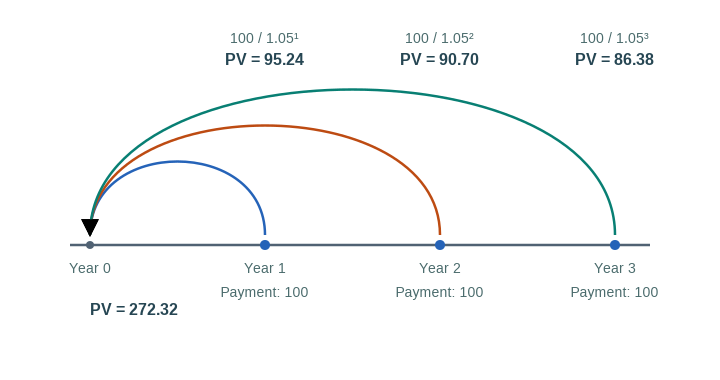
3. Nominal rates: one rate, several payments a year
Markets often quote a nominal annual rate convertible times a year, written . It means a rate of is credited each of a year. Equivalence with an effective annual rate is a single equation: one year of growth must be the same either way.
Discount works the same way. A nominal discount rate takes at the start of each of a year:
Putting both on one line makes conversions mechanical:
A nominal discount quotation is converted on its own base. An 8% nominal discount rate convertible quarterly takes 2% at the start of each quarter, so and . Treating the same 8% as nominal interest would give : a different contract, and a wrong answer by 0.17 percentage points.
Example 3.1: One rate, five descriptions
At an effective annual rate of 7%:
| Measure | Value | How it is obtained |
|---|---|---|
| 7.0000% | given | |
| 6.5421% | ||
| 6.7850% | ||
| 6.7090% | ||
| 6.7659% |
Notice the ordering . Discount rates sit below interest rates, and more frequent conversion pulls both towards from opposite sides. This ordering is a fast sanity check on any conversion.
Interest and discount at the same frequency.
From , when :
4. The force of interest
Let the number of conversions grow without limit. The nominal rate converges to the force of interest, the instantaneous growth rate of the fund:
Why this definition. Over a short interval , the fund grows by about on a balance of , so the rate per unit time is . It is a percentage rate, not a dollar rate, which is what lets us compare funds of different sizes.
Integrating both sides from 0 to and using :
When the force is constant, , and comparing with gives .
Example 4.1: A force that rises over time
A fund credits interest at force . The accumulated value of 1 after 5 years is
The common slip is to evaluate , which treats the year-5 rate as if it applied all along.
4.1 Rates that change at set dates
Because forces add over consecutive intervals (), accumulation factors multiply. If a fund earns 3% in year 1 and 7% in year 2, it grows by . The average rate, 5%, would give . The gap is small here but grows with the spread of the rates and the number of years. Split the interval at every rate change and multiply.
4.2 Ordering the rates, and two quick approximations
For any effective annual interest rate and compounding frequencies and :
Using Taylor series expansions around :
Subtracting:
Hence, to a second-order approximation:
5. Equations of value
Because money at different dates is not comparable, every problem is solved by moving all payments to one date (the comparison date) with or , then setting inflows equal to outflows. Under compound interest the choice of comparison date does not change the answer: moving the whole equation by years multiplies both sides by .
Example 5.1: Solving for an unknown time
A saver deposits 1,500 now and 1,000 in three years at 4.5% effective. When will the account reach 3,200?
Compare at time :
Factor out : , so and
Example 5.2: Solving for an unknown rate
6,500 invested today becomes 9,100 in seven years. The effective rate solves , so .
5.1 The rule of 72
The time to double at rate is exactly . Since for small and , a doubling time is roughly . Using 72 instead of 69 corrects for the curvature of at typical rates. At 6% the rule gives 12 years against an exact 11.90. Use it to check answers, not to produce them.
5.2 Real and nominal rates
Inflation is another accumulation process, of prices instead of money. If money grows at and prices at , purchasing power grows by the ratio of the two factors:
At 6% interest and 2.5% inflation, . The shortcut "6% minus 2.5%" gives 3.5%; it is an approximation that gets worse as either rate grows, not the definition.
5.3 Moving the focal date
5.4 Equated time
Suppose an obligor owes payments due at times . The obligor wishes to settle all debts with a single payment of at time .
- Exact Equated Time ():
- Approximate Method of Equated Time (): Using a weighted arithmetic average:
6. Case study: where should Riverstone keep its cash?
Mira has three quotes for the fund's 2,000,000 of short-term cash.
| Bank | Quote |
|---|---|
| Alder Bank | 5.8% nominal annual interest, convertible monthly |
| Birch Bank | 5.6% nominal annual discount, convertible quarterly |
| Cedar Bank | a constant force of interest of 5.75% |
Step 1: put every quote on the same footing. Convert each to an annual effective rate.
| Bank | Calculation | Annual effective rate |
|---|---|---|
| Alder | 5.957% | |
| Birch | 5.802% | |
| Cedar | 5.919% |
The quote with the lowest headline number is not the worst, and the highest headline is not automatically the best: Birch's 5.6% is a discount rate, so it is worth more than 5.6% of interest, but still less than the other two.
Step 2: what the choice is worth. Over 18 months, 2,000,000 grows to at Alder and to at Birch. The difference, 4,786.87, is the cost of comparing headline rates instead of effective rates.
Step 3: an equation of value. The fund must pay 1,200,000 in 6 months and 900,000 in 18 months. At Alder's effective rate, the cash needed today is
So 9,036.50 of the 2,000,000 is not needed for these payments and can be invested for longer.
Step 4: an unknown time. The trustees ask how long money left at Alder takes to double: years. The rule of 72 gives years, a useful mental check but not an exact answer.
7. Common traps
Trap 1: Confusing Simple Interest Effective Rates Across Periods
Under simple interest , the effective interest rate in the -th period is , which strictly decreases as increases. A frequent exam trap quotes an effective interest rate in year under simple interest and asks for the simple interest rate or the effective rate in year : solve before proceeding.
Trap 2: Discounting with Instead of
When given an effective interest rate , the one-period discount factor is , not . The factor is valid only when is explicitly defined as an effective discount rate.
Trap 3: Nominal Discount Rate Direction of Compounding
For a nominal discount rate convertible times per year, the one-year accumulation factor is , with a minus sign inside the parentheses and a negative exponent. Using treats a discount quotation as a nominal interest quotation.
Trap 4: Integrating Over Instead of
When a deposit is made at time under a time-varying force of interest , its accumulated value at is . Evaluating is valid only when is constant; for time-varying , .
Trap 5: Forgetting Chain Rule Constants in Rational Force of Interest
When , the antiderivative is , not . Missing the division by changes the exponent of the polynomial accumulation function.
Trap 6: Focal Date Dependence Under Simple Interest
Under compound interest, the solution to an equation of value is invariant to the choice of focal date because . Under simple interest, , so an equation of value under simple interest requires an explicitly stated comparison date.
Trap 7: Mixing Monthly Compounding with Quarterly Deposits
When interest is quoted as and payments occur quarterly, convert to the effective quarterly rate before applying any quarterly equation of value. Never divide by 4.
Trap 8: Piecewise Force of Interest Continuity at Breakpoints
When changes formula at (for example, on and on ), split the integral at the breakpoint: . Multiplicatively, .
Trap 9: Solving Quadratic Equations
When a problem gives or , use the identity so that , which reduces immediately to the quadratic . Taking the positive root saves several minutes of algebra.
Trap 10: Real vs. Nominal Return Approximation Slip
The exact Fisher equation is , so . Subtracting overstates the real rate by , which is enough to land on a distractor on SOA Exam FM.
Trap 11: Method of Equated Time Bias Direction
The approximate method of equated time is the arithmetic mean of payment dates. By Jensen's inequality on the strictly convex function , , which implies the exact equated time satisfies . Thus always favors the borrower (delays payment).
Trap 12: Commercial Discount (Simple Discount) vs. Compound Discount
Bankers' discount (simple discount) uses for . Unlike compound discount , simple discount implies an increasing effective interest rate as maturity approaches . Always check whether a T-bill problem specifies simple discount or compound discount.
Trap 13: Interpreting "Interest Earned During the -th Year"
The dollar amount of interest earned during the -th year on an investment of is , not . Under compound interest, the -th year dollar interest is , which grows geometrically at rate each year.
Trap 14: Unknown Time withOpposite-Sign Cash Flows on BA II Plus
When solving on the BA II Plus TVM worksheet, you must enter PV as negative (+/-) and FV as positive (or vice versa) with PMT = 0. If both have the same sign, pressing [CPT] [N] returns Error 5.
Trap 15: Ordering Sanity Check Before Selecting an Option
For any positive rate environment, the strict inequality always holds, and . If you are given and asked for , any choice above or below can be eliminated immediately.
8. Practice problems
Problem 1: From a nominal discount rate
A lender quotes a nominal discount rate of 6% convertible quarterly. Find the equivalent effective annual interest rate.
- A6.14%
- B6.23%
- C6.00%
- D6.38%
- E6.09%
Solution: Each quarter the lender takes up front, so one quarter's growth factor is . Over a year, , so . Answer (B).
Why the other choices are wrong:
- (A) Treats the quote as nominal interest, , so a discount is handled as if it were interest.
- (C) Gives the headline nominal rate, which is neither effective nor interest.
- (D) Treats 6% as an annual effective discount rate, , ignoring the quarterly conversion.
- (E) Divides the nominal rate by , a one-quarter adjustment that never compounds.
Problem 2: Integrating a varying force
A deposit of 800 earns interest at force . Find its value at time 3.
- A957.77
- B1017.00
- C972.25
- D956.00
- E966.36
Solution: , so the value is . Answer (C).
Why the other choices are wrong:
- (A) Integrates the term as instead of .
- (B) Forgets to halve the term, using .
- (D) Uses the integral as simple interest, , instead of exponentiating it.
- (E) Takes the average force as an annual effective rate and compounds it, .
Problem 3: Present value at an effective rate
What must be invested today at 6% effective to have 5,000 in four years?
- A3903.74
- B4032.26
- C3800.00
- D3960.47
- E4716.98
Solution: . Answer (D).
Why the other choices are wrong:
- (A) Discounts at a 6% discount rate, , instead of 6% interest.
- (B) Uses simple interest, .
- (C) Uses simple discount, .
- (E) Discounts for one year instead of four.
Problem 4: Monthly nominal rate
Find equivalent to an effective rate of 5%.
- A4.8691%
- B5.1162%
- C4.8790%
- D4.8889%
- E0.4074%
Solution: . Answer (D).
Why the other choices are wrong:
- (A) Gives , the nominal discount rate, instead of .
- (B) Runs the conversion backwards, , treating 5% as the nominal rate.
- (C) Gives the force of interest , the limit as the conversions become continuous.
- (E) Stops at the monthly effective rate and forgets to multiply by 12.
Problem 5: Variable Force of Interest Accumulation
Problem: An investment fund grows under a continuous force of interest given by:
A payment of 10,000 is made at time , and an additional deposit of 5,000 is made at time . Find the total fund value at time .
Solution:
- Compute the general accumulation factor from to :
Let , so .
Therefore:
- Evaluate the accumulation factors between payment dates:
- For deposit at to :
- For deposit at to :
- Calculate total accumulated value at :
Problem 6: Nominal Rate Equivalence and Unknown Payment
Problem: An investor deposits 2,000 today into an account earning a nominal discount rate of convertible quarterly. At time years, the investor deposits an unknown amount . At time , the interest basis switches to a nominal interest rate of compounded monthly. The total accumulated fund balance at years is 8,000. Determine .
Solution:
- Analyze Period 1 ():
- Quarterly discount rate: .
- Quarterly accumulation factor: .
- Over 4 years, there are quarters.
- For the initial 2,000 deposited at , value at :
- For deposit at , there are quarters:
- Total fund at :
- Analyze Period 2 ():
- Monthly interest rate: .
- Duration is years, which equals months.
- Accumulation factor: .
- Equation of value at :
Problem 7: Accumulation Under a Rational Force of Interest
An investment fund accumulates under a continuous force of interest for . A deposit of 1,500 is made at time , and a second deposit of 2,500 is made at time . Calculate the total accumulated value of the fund at time .
- A5,470.00
- B6,400.00
- C5,219.78
- D4,930.00
- E5,736.34
Solution:
- Integrate the force of interest: , so . This force produces simple interest from time 0.
- , , .
- Each deposit grows by :
Answer (C).
Why the other choices are wrong:
- (A) Applies simple interest from each deposit date, , but this force gives simple interest from time 0 only.
- (B) Grows both deposits by as if they were made at time 0.
- (D) Uses instead of the ratio .
- (E) Treats the force as 6% compound interest instead of integrating it.
Problem 8: Difference Between Effective Interest and Effective Discount
For a certain investment account, the annual effective interest rate and the annual effective discount rate satisfy . Calculate the equivalent nominal rate of interest convertible quarterly.
- A8.26%
- B7.93%
- C8.61%
- D8.35%
- E2.09%
Solution:
- Use the fundamental identity :
- Solve the quadratic equation for :
- Compute the equivalent nominal rate convertible quarterly:
Answer (D).
Why the other choices are wrong:
- (A) Gives the force of interest instead of .
- (B) Gives the effective discount rate .
- (C) Stops at the effective rate and never converts it to a quarterly nominal rate.
- (E) Stops at the quarterly effective rate and forgets to multiply by 4.
Problem 9: Equivalence of Simple Interest and Compound Discount
Fund A accumulates at a simple interest rate of per annum. Fund B accumulates at a compound annual effective discount rate . An deposit of 1,000 in each fund produces the exact same accumulated value at the end of 5 years. Calculate the accumulated value of 1,000 in Fund B at the end of 10 years.
- A1,900.00
- B1,450.00
- C2,102.50
- D2,900.00
- E2,567.95
Solution:
- At , Fund A has accumulated value .
- Fund B accumulates by . Equating the 5-year accumulation factors:
- At , Fund B's accumulation factor is the square of its 5-year factor:
Notice we do not even need to solve explicitly for ! Answer (C).
Why the other choices are wrong:
- (A) Accumulates Fund A for 10 years at simple interest instead of Fund B.
- (B) Gives the 5-year value, not the 10-year value.
- (D) Doubles the 5-year value instead of squaring the 5-year factor.
- (E) Uses in Fund B, copying the simple interest rate instead of matching the 5-year values.
Problem 10: Matching -th Year Effective Rates
Account X earns simple interest at an annual rate of . Account Y earns compound interest at an annual effective rate of . In the 6th year, the effective rate of interest in Account X equals the effective rate of interest in Account Y. Calculate the accumulated value of 2,000 deposited in Account X at time at the end of 8 years.
- A3,066.67
- B3,000.00
- C2,954.91
- D2,800.00
- E3,142.86
Solution:
- The effective rate in the 6th year under simple interest is:
- Since Account Y earns a constant effective annual rate of , we set :
- Accumulate 2,000 in Account X for 8 years:
Answer (A).
Why the other choices are wrong:
- (B) Uses for the 6th-year rate, which is the 5th-year rate.
- (C) Accumulates in Account Y at 5% compound instead of in Account X.
- (D) Sets , matching the simple rate itself rather than the 6th-year effective rate.
- (E) Uses for the 6th-year rate, which is the 7th-year rate.
Problem 11: Nominal Interest vs. Nominal Discount Conversion
An insurer credits interest on a policy reserve at a nominal annual discount rate of convertible monthly during the first 3 years, and at a nominal annual interest rate of convertible quarterly during the next 4 years. Calculate the accumulated value at the end of 7 years of a single deposit of 10,000 made at time 0.
- A15,152.95
- B15,164.00
- C15,226.25
- D15,138.86
- E15,075.82
Solution:
- During the first 3 years ( months), the monthly discount rate is :
- During the next 4 years ( quarters), the quarterly interest rate is :
- Multiply the two interval accumulation factors:
Answer (B).
Why the other choices are wrong:
- (A) Treats as nominal interest, .
- (C) Treats as nominal discount, .
- (D) Uses the nominal rates as annual effective rates, .
- (E) Handles the discount period correctly but treats as an annual effective rate, .
Problem 12: Dollar Interest Earned in Specific Years
An investor places into a fund earning compound interest at an annual effective rate . The amount of interest earned during the 4th year is 486.00, and the amount of interest earned during the 7th year is 646.87. Calculate the initial deposit .
- A4,016.53
- B3,651.39
- C4,860.00
- D3,319.45
- E365.14
Solution:
- Under compound interest the interest earned in year is .
- The ratio removes and : , so .
- From the 4th year: , so and .
Answer (B).
Why the other choices are wrong:
- (A) Uses , the exponent for year 3.
- (C) Ignores the growth before year 4, setting .
- (D) Uses , the exponent for year 5.
- (E) Divides by but forgets the factor in the year-4 interest.
Problem 13: Force of Interest Defined by an Accumulation Polynomial
An accumulation function is given by for . Calculate the force of interest at time .
- A6.45%
- B8.00%
- C4.84%
- D6.44%
- E6.85%
Solution:
- Differentiate with respect to :
- Evaluate and :
- Compute :
Answer (A).
Why the other choices are wrong:
- (B) Gives and forgets to divide by .
- (C) Differentiates as , losing the factor 2.
- (D) Gives the effective rate for year 4, , not the force at .
- (E) Gives the effective rate for year 5, , not the force at .
Problem 14: Exact vs. Approximate Equated Time
A borrower owes 3,000 due in 2 years and 5,000 due in 6 years. The borrower arranges to pay a single lump sum of 8,000 to settle both debts at an annual effective interest rate of . Calculate the absolute difference (in years) between the approximate equated time and the exact equated time .
- A4.500 years
- B4.371 years
- C0.129 years
- D0.296 years
- E4.000 years
Solution:
- Compute the approximate equated time (weighted arithmetic mean):
- Compute the present value of the two debts at :
- Solve for the exact equated time where :
- Take the difference:
Answer (C).
Why the other choices are wrong:
- (A) Gives the approximate equated time itself instead of the difference.
- (B) Gives the exact equated time itself instead of the difference.
- (D) Stops at and never divides by .
- (E) Gives the gap between the two due dates, , which is not an equated time.
Problem 15: Piecewise Force of Interest with Intermediate Withdrawal
An investor deposits 4,000 at time into a fund subject to force of interest:
At time , the investor withdraws . The remaining balance grows to 4,500 at time . Calculate .
- A751.27
- B1,887.62
- C9.99
- D1,370.44
- E1,074.78
Solution:
- Accumulate the initial 4,000 to time :
- After withdrawing at , the balance accumulates from to :
- Set the accumulated value at equal to 4,500:
Answer (E).
Why the other choices are wrong:
- (A) Holds the force at over instead of integrating .
- (B) Forgets to halve when integrating, using .
- (C) Ignores the growth after the withdrawal, setting the remaining balance equal to 4,500.
- (D) Integrates from 0 to 6 instead of from 3 to 6.
Problem 16: Solving for an Unknown Interest Rate in a Three-Payment Equation of Value
An investor makes deposits of 1,000 at time and 2,000 at time . The accumulated value of the account at time is 3,670. Calculate the annual effective interest rate .
- A5.17%
- B7.75%
- C10.60%
- D8.38%
- E16.10%
Solution:
- Set up the equation of value at time and let :
- Divide by 10 and apply the quadratic formula:
- Solve for from :
Answer (B).
Why the other choices are wrong:
- (A) Treats all 3,000 as invested for the full 4 years.
- (C) Treats all 3,000 as invested for only 2 years.
- (D) Uses simple interest, .
- (E) Solves for and then reads as , forgetting the square root.
Problem 17: Real Rate of Return With Inflation and Tax on Nominal Interest
A savings certificate pays a nominal annual interest rate of compounded semiannually. An investor is subject to a tax on all interest earned at the end of the year, and annual inflation over the year is . Calculate the investor's after-tax real annual effective rate of return.
- A3.53%
- B6.12%
- C3.41%
- D3.62%
- E5.50%
Solution:
- Compute the pre-tax effective annual interest rate:
- Apply the income tax to the interest earned:
- Deflate by the inflation rate using the exact Fisher equation:
Answer (A).
Why the other choices are wrong:
- (B) Stops at the after-tax nominal rate and never adjusts for inflation.
- (C) Ignores the semiannual compounding, taxing instead of .
- (D) Subtracts the inflation rate instead of dividing by .
- (E) Ignores the tax and the compounding and subtracts inflation from the nominal rate.
Problem 18: Discount Factor Identity Across Horizon Tripling
At a constant annual effective interest rate , the present value of 1,000 due in years is 760. Calculate the accumulated value at time of 2,500 invested at time .
- A4,868.42
- B4,328.25
- C1,900.00
- D5,695.07
- E3,289.47
Solution:
- From the present value of 1,000 due at , extract :
- Since , the accumulation factor over years is:
- Multiply by the initial deposit of 2,500:
Answer (D).
Why the other choices are wrong:
- (A) Triples the interest of one period, which is simple interest, instead of cubing the factor.
- (B) Uses the factor for years instead of .
- (C) Multiplies by , discounting instead of accumulating.
- (E) Accumulates for years instead of .
Problem 19: Time Required for One Fund to Overtake Another
Investor A deposits 1,200 at time into an account earning a constant force of interest . Investor B deposits 900 at time into an account earning an effective annual discount rate of . Calculate the time (in years) when the two accounts have equal balances.
- A7.78 years
- B8.62 years
- C10.67 years
- D9.58 years
- E5.75 years
Solution:
- Write the balance functions at time :
- Equate and take natural logarithms:
- Since :
Answer (B).
Why the other choices are wrong:
- (A) Uses as a force for Fund B instead of .
- (C) Treats Fund B's 8% as an interest rate, using instead of .
- (D) Uses the discount rate 0.08 itself as Fund B's force of interest.
- (E) Lets only Fund A grow, , and ignores Fund B's interest.
Problem 20: Early Withdrawal Penalty and Effective Yield Realized
A 5-year certificate of deposit credits a nominal annual rate of compounded quarterly. If the holder withdraws the balance before maturity, a penalty equal to the last 2 quarters of interest is forfeited. An investor deposits 10,000 at and withdraws the entire net balance at the end of 3 years. Calculate the effective annual yield realized by the investor over the 3-year holding period.
- A5.09%
- B5.35%
- C4.99%
- D3.02%
- E6.14%
Solution:
- The quarterly interest rate is . Over 3 years ( quarters), forfeiting the last 2 quarters of interest leaves exactly quarters of compounded growth:
- Set to find the realized annual effective yield :
Answer (A).
Why the other choices are wrong:
- (B) Divides the total gain by 3, a simple average that ignores compounding.
- (C) Gives the nominal rate convertible quarterly instead of the effective annual yield.
- (D) Forfeits 2 quarters for every year held instead of 2 quarters in total.
- (E) Gives the effective rate with no penalty.
Problem 21: Reading a discount quote
A bank quotes Riverstone a nominal annual discount rate of convertible quarterly. Find the equivalent annual effective interest rate.
- A5.72%
- B5.93%
- C5.80%
- D5.48%
- E5.60%
Solution: . Answer (C).
Why the other choices are wrong:
- (A) Treats the quote as nominal interest, .
- (B) Applies to the nominal rate, skipping the quarterly conversion.
- (D) Gives the effective discount rate instead of the interest rate.
- (E) Gives the headline nominal discount rate.
Problem 22: Cash needed for two known payments
Riverstone must pay 1,200,000 in 6 months and 900,000 in 18 months. Its cash earns an annual effective rate of . Find the amount needed today.
- A2,217,678.73
- B1,990,219.71
- C2,100,000.00
- D1,161,262.06
- E1,990,736.62
Solution: . Answer (B).
Why the other choices are wrong:
- (A) Accumulates the payments instead of discounting them.
- (C) Ignores interest and adds the two payments.
- (D) Reads 6 and 18 as years instead of months.
- (E) Discounts at simple interest, .
Problem 23: Doubling time
Money in a Riverstone reserve earns an annual effective rate of . How many years does it take to double?
- A11.01
- B15.38
- C11.08
- D12.01
- E10.66
Solution: . Answer (A).
Why the other choices are wrong:
- (B) Uses simple interest, .
- (C) Gives the rule-of-72 estimate .
- (D) Adds a year to the exact doubling time.
- (E) Divides by instead of .
9. Check it in code
import math

def convert(i: float) -> dict:
    """Every standard measure equivalent to an effective annual rate i."""
    return {
        "d": i / (1 + i),
        "i12": 12 * ((1 + i) ** (1 / 12) - 1),
        "d4": 4 * (1 - (1 + i) ** (-1 / 4)),
        "delta": math.log(1 + i),
    }

def accumulate(delta, start: float, end: float, steps: int = 1000) -> float:
    """exp of the integral of a varying force, by the trapezoidal rule."""
    h = (end - start) / steps
    area = sum((delta(start + k * h) + delta(start + (k + 1) * h)) * h / 2 for k in range(steps))
    return math.exp(area)

print(convert(0.07))                                    # matches the table in Example 3.1
print(800 * accumulate(lambda t: 0.05 + 0.01 * t, 0, 3))  # 972.25, Problem 2
Extended Algorithmic Verification Suite
"""
Module 1: Time Value of Money Numerical Solver
"""
import math
from typing import Callable

def effective_to_nominal_interest(i: float, m: int) -> float:
    """Computes nominal interest rate i^(m) equivalent to effective annual rate i."""
    return m * ((1.0 + i) ** (1.0 / m) - 1.0)

def effective_to_nominal_discount(i: float, p: int) -> float:
    """Computes nominal discount rate d^(p) equivalent to effective annual rate i."""
    v = 1.0 / (1.0 + i)
    return p * (1.0 - v ** (1.0 / p))

def nominal_discount_to_effective(d_p: float, p: int) -> float:
    """Computes effective rate i from nominal discount rate d^(p)."""
    v_1_p = 1.0 - (d_p / p)
    v = v_1_p ** p
    return (1.0 / v) - 1.0

def accumulate_variable_force(c_list: list[tuple[float, float]], delta_func: Callable[[float], float], target_t: float, n_steps: int = 1000) -> float:
    """
    Computes total accumulated value at target_t for arbitrary cash deposits:
    c_list: list of tuples (deposit_amount, deposit_time)
    delta_func: continuous force of interest function delta(t)
    Numerical integration using Simpson's 1/3 Rule.
    """
    total_val = 0.0
    for amount, t_dep in c_list:
        if t_dep > target_t:
            continue
        # Integrate delta from t_dep to target_t
        h = (target_t - t_dep) / n_steps
        integral = delta_func(t_dep) + delta_func(target_t)
        for step in range(1, n_steps):
            t_curr = t_dep + step * h
            weight = 4.0 if step % 2 == 1 else 2.0
            integral += weight * delta_func(t_curr)
        integral *= (h / 3.0)
        total_val += amount * math.exp(integral)
    return total_val

if __name__ == "__main__":
    # Test rate ordering
    i = 0.08
    d = i / (1.0 + i)
    delta = math.log(1.0 + i)
    i_2 = effective_to_nominal_interest(i, 2)
    i_12 = effective_to_nominal_interest(i, 12)
    d_2 = effective_to_nominal_discount(i, 2)
    d_12 = effective_to_nominal_discount(i, 12)

    print(f"d ({d:.6f}) < d_2 ({d_2:.6f}) < d_12 ({d_12:.6f}) < delta ({delta:.6f}) < i_12 ({i_12:.6f}) < i_2 ({i_2:.6f}) < i ({i:.6f})")
    assert d < d_2 < d_12 < delta < i_12 < i_2 < i, "Rate inequality violated!"
    print("M1 Rate Inequality Verified Successfully.")